

4 November 2026 by Simon Noble
Raw, Natural and Ethical Honey: What Are You Really Buying?
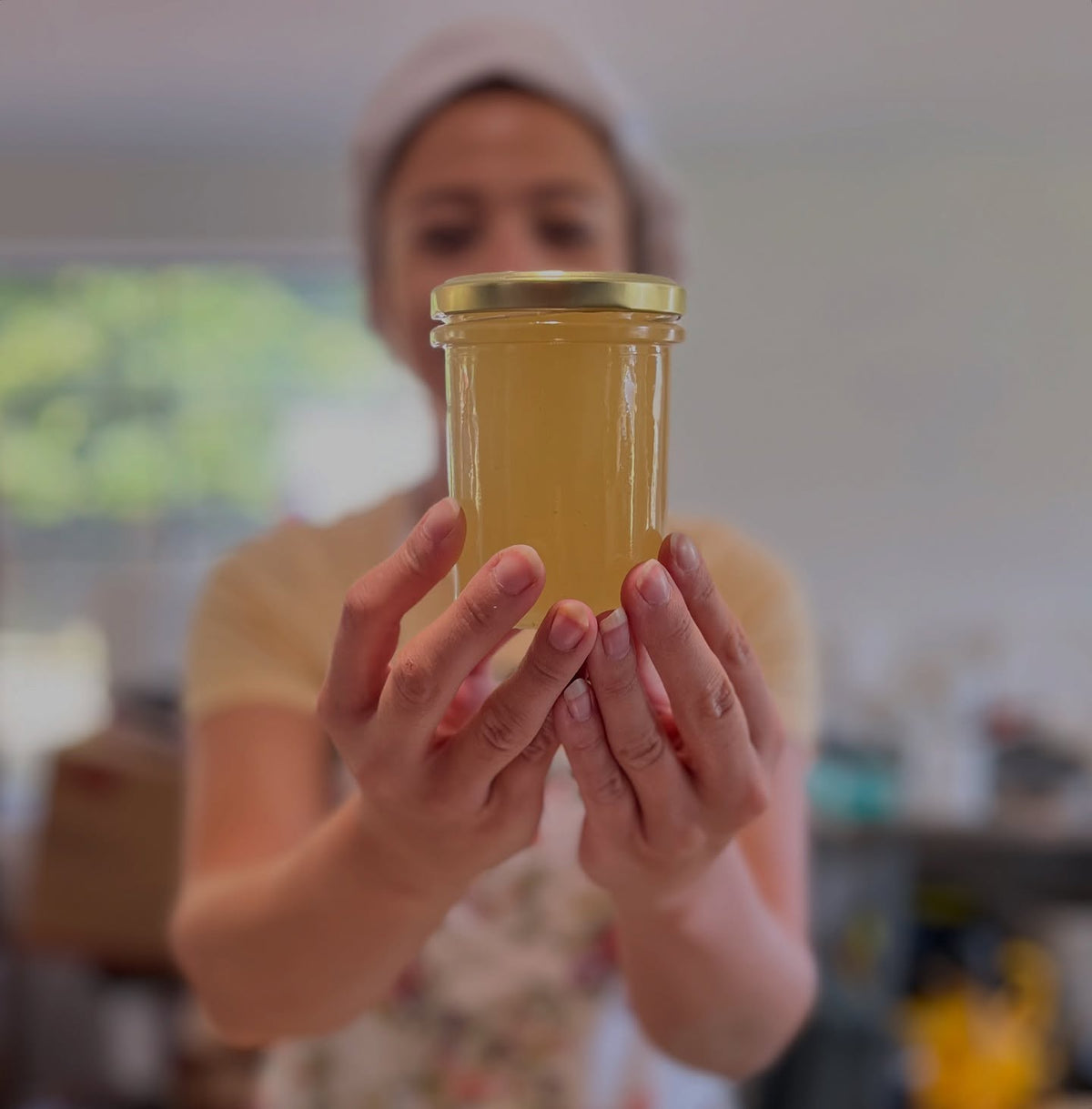
People often ask me what the difference is between the honey I produce and the jars on a supermarket shelf. It's a fair question. Both say honey on the label, both look much the same, and one can cost a great deal less than the other.
The short answer is that raw honey is honey taken from the hive, strained to remove bits of wax and put in a jar. It's never heated or finely filtered. The longer answer takes in a huge amount of additional detail, such as where the honey came from, how the bees were treated and whether everything in the jar came from a hive at all.
I'm Simon Noble, and I look after more than 100 hives across the New Forest. My family has worked with bees for three generations. Some of my earliest memories of honey are of helping my Dad spin it out at the end of summer, before he sold it in the farm shop. Back then we just called it honey! These days there are a lot more words on the label, so here's what I think they mean.
What is natural honey?
Under the Honey (England) Regulations 2015, honey is a natural product made by honeybees from plant nectar or other plant secretions. It has to meet compositional standards and nothing can be added to it. That's why the ingredients list on our jars is one word long. It's just honey!
Chemically, honey is mostly glucose and fructose, but that isn't the whole story. Depending on the flowers, it also contains small amounts of organic acids, enzymes, amino acids, minerals and phenolic compounds, which is partly why real honey varies so much. One harvest can be pale, delicate and runny, while another is dark, strong and quick to set.
I see this first hand. Even from the same apiary, no two batches of our wildflower honey are the same, because the flavour depends upon whatever is flowering at the time. Bucklers Hard gives us apple blossom, lime and blackberry. At Brockenhurst Park, an avenue of horse chestnuts can turn the honey markedly darker. The woodland around Greenrollestone Copse produces a soft set honey with a velvety texture.
We celebrate those differences rather than blending them away. We harvest each site separately and every jar tells you the story of the apiary it came from.
What is raw honey?
Raw honey is honey that has had as little done to it as possible after leaving the hive. There is no legal definition of raw honey in the Honey (England) Regulations, unlike terms such as blossom honey, filtered honey and comb honey which are protected. So when you see the word on a label, it's worth doing a little research into what the producer means by it.
Here's what we mean. We coarsely filter our honey to remove wax and debris, then it goes in the jar. We never heat it or pasteurise it, and everything is harvested, processed and packed by us at Furzedown Farm.
We do it that way for two reasons. The first is that UK rules say honey must not be heated to the point that its natural enzymes are destroyed or significantly inactivated, and studies have shown that thermal processing can affect honey's enzyme activity and phenolic compounds. How much depends on the honey, the temperature and how long it's heated.
The second is that fine filtration would remove far too much of the 'good stuff' from the final product. Honey that has had a significant part of its pollen taken out has to be sold as filtered honey, and pollen is one of the things that tells you where a honey came from. If you leave it in, the aroma, texture and flavour of a particular place tends to come with it.
Why does raw honey crystallise?
If your honey turns cloudy, thickens or sets solid, nothing has gone wrong. Crystallisation is a natural process, and different honeys do it at different speeds depending on their sugars, the temperature and other factors.
To make it runny again, stand the jar in warm water below 40°C. Large producers may process honey partly to give it a uniform, predictable consistency. Small-batch raw honey doesn't always behave so politely...but we rather like it that way!
Is raw honey better for you?
There are plenty of extravagant health claims about raw honey online, but I'd treat them with caution. Honey is still mostly sugar. I'm a beekeeper rather than a doctor, and I'd much rather you bought our honey because of how it tastes (quite delicious even if we say so ourselves).
Researchers are interested in the enzymes and plant compounds found in honey, but the evidence for specific health benefits is limited. What we can say with more confidence is that processing changes what's in the jar. If you want honey as close as possible to what the bees made, minimally processed raw honey is the way to go.
What is ethical honey?
For me, ethical honey starts with a simple principle: the welfare of the bees comes before the size of the honey crop. A jar can contain perfectly genuine honey and still tell you very little about how the colony behind it was treated.
I learned what I didn't want early on. In 2016 I spent four months in New Zealand working for a commercial beekeeper with 3,500 hives. It was an incredible experience and I learned a huge amount, but at that scale the aim is to get round the hives as quickly as possible and harvest as much as you can. It felt more like bee labouring than the traditional craft of beekeeping.
I wanted to keep things small enough that I could truly care for my bees.
How much honey should a beekeeper take?
Honey isn't made for us. Bees make it as a food store, gathering nectar while it's abundant so the colony has the energy to survive when flowers aren't producing, most importantly through winter. That's when the bees draw together in a tight cluster and live on what they gathered in summer.
A beekeeper therefore has a choice about how much to remove. We only ever take the surplus, and I always make sure each colony has enough of its own honey stored to see it through winter. The alternative is to take as much as possible and routinely replace those stores with sugar syrup. That's never an approach I want to take.
There are times when any responsible beekeeper needs to feed their bees. If a colony is at risk of starvation, feeding can save it, and the bees come first. The distinction I'd draw is between necessary feeding and feeding designed around maximising the amount of honey you can harvest.
What else makes beekeeping ethical?
How much you take is only part of it. Here are a few of the other things we think about:
- We keep our bees in nature reserves, wildflower meadows and country estates that prioritise conservation and biodiversity. Where we can, we avoid monoculture crops such as oilseed rape.
- We use a one-way board to clear the bees gently from the frames.
- Looking after bees now includes watching for Asian hornets, which prey on honeybees at the hive entrance.
What is fake honey?
Fake honey usually means honey bulked out with cheaper sugar syrup. Selling that as pure honey is illegal in England, but honey is an attractive target for fraud. It's largely made of sugars, and modern syrups made from rice, beet, corn, wheat and other sources can be surprisingly hard to detect.
Genuine honey needs millions of flowers, healthy colonies, good weather, skilled beekeepers and time. Industrial sugar syrup needs far less of all of that, and if it can be blended into honey undetected, the potential profit is obvious.
Is supermarket honey real? What UK testing found
In 2024, the Honey Authenticity Network UK sent 30 jars for DNA-based testing: five from UK beekeepers and 25 from major retailers. Twenty four of the 25 retail samples were flagged as suspicious, while all five beekeeper samples were judged genuine. The one retail jar that passed was also British honey.
The test examines millions of DNA sequences in each sample and compares the results with profiles of authentic honey. The same kind of test on 30 samples from German supermarkets flagged 25 of them.
What did European testing of imported honey find?
A separate European Commission investigation, From the Hives, analysed 320 samples of honey arriving at EU borders. It found 147 of them, or 46%, suspicious of being non-compliant because markers of added sugars were detected.
What do these results actually prove?
They prove less than the headlines suggest, and I think it's only fair to say so, particularly as I sell honey for a living and have an obvious interest in all this.
The DNA method has been challenged by parts of the honey importing and packing industry. The UK Government says no single test can definitively determine a honey's authenticity, and the National Food Crime Unit's 2024 assessment concluded it is unlikely that adulterated honey is broadly present on the UK market. Thirty jars can't tell you that 90% of supermarket honey in Britain is fake, and the EU figure covers imported consignments identified as suspicious rather than every jar on sale.
Even so, two investigations using different methods have raised serious questions about cheap, globally traded honey, and I understand why shoppers are asking them too. My own view is that counterfeit honey is a major issue for our industry, and that awareness of it is growing. I can't tell you whether any particular jar on a shelf is genuine, but I can tell your with certainty that ours is.
Why is honey so difficult to test?
Genuine honey is the opposite of a standardised substance. Its composition varies with the flowers, geography, climate, season and even the colony that produced it. That's what makes it interesting to eat and extremely complicated to police.
Scientists use pollen analysis, isotope analysis, chromatography, mass spectrometry, nuclear magnetic resonance and, increasingly, DNA based methods. In 2025, the Food Standards Agency said more development work was needed before newer DNA methods could provide reliable tests for imported honeys and blends.
Why is some honey so cheap?
A low price doesn't prove anything on its own, but it's reasonable to wonder how it was achieved. Think about what goes into a single jar. A colony of tens of thousands of bees forages across millions of flowers. The beekeeper has to maintain the colonies, monitor their health, control pests and diseases, move hives, harvest, extract, jar and label the honey, then get it to you.
There are also years when the weather simply doesn't cooperate. I've said before that being a bee farmer is the hardest way to make an easy living. When a jar has travelled through an international supply chain and still sells for an extraordinarily low price, I think it's fair to ask questions.
How can you tell whether you're buying good honey?
Look for traceability. Most popular home tests for fake honey aren't reliable. Whether honey dissolves in water, sticks to your thumb or crystallises can't tell you whether it has been altered.
The label is a good place to start, although it may not get you far. In England, a blended honey can be labelled simply as a blend of honeys from more than one country. Since June 2026, EU rules have required blends to list each country and its percentage, and the British Beekeepers Association has asked the UK government to follow.
Better still, buy directly from a beekeeper. It doesn't have to be me. Any good local producer should be able to answer these questions:
- Which apiary or area did this honey come from?
- Which flowers were the bees likely to have been visiting?
- When was it harvested?
- How was it extracted, and has it been heated or finely filtered?
- How are the colonies looked after, and how much honey is left for them?
Raw honey vs supermarket honey
These are the differences you're most likely to find between a beekeeper's raw honey and a mass-produced blend, although every producer is different.
|
|
Raw honey from a beekeeper |
Mass-produced blended honey |
|---|---|---|
|
Origin |
A named apiary or local area |
Often several countries, which may not be named |
|
Processing |
Coarsely strained |
Often heated and finely filtered |
|
Texture |
Varies, and may set over time |
Consistent and slower to set |
|
Flavour |
Changes with the site and season |
Blended to taste the same each time |
|
Traceability |
You can ask the person who harvested it |
Passes through a longer supply chain |
How we produce honey at The Noble Bee
The Noble Bee began in January 2014, when a storm brought down a beech tree with a wild colony of bees living in its hollow. A beekeeper called Jan Roper came out to rescue them, I watched her work, and I went straight home and booked a beginners' course. You can read the rest of our story here.
Today our bees live at around ten apiaries, including Needs Ore Nature Reserve, the mouth of the Beaulieu River and our home at Furzedown Farm. We harvest three times a season: after the spring flowers, after the summer flowers and after the heather.
Each August, by arrangement with Forestry England, we move our strongest hives onto the heathland for about six weeks to make our New Forest Heather Honey. It's strongly flavoured and aromatic, with a jelly-like consistency that means it has to be pressed from the comb in an apple press. That's why a jar can contain small traces of pollen, propolis and beeswax.
We don't expect every batch to taste the same. That approach earned us a three star Great Taste Award in 2023, when we were the only British honey producer to receive one. We're also a certified New Forest Marque producer.
You can browse our raw New Forest honey, or come and see where it's made. Our beekeeping experience days include opening a hive and tasting honeys from around the world, and they're the quickest way I know of showing someone how different honey can be. If you'd like to go further, I've written about keeping bees in your garden.
Raw honey FAQs
What's the difference between raw honey and regular honey?
Raw honey has had minimal processing, so it hasn't been heated or finely filtered. Regular supermarket honey is more likely to be a blend that has been processed to keep it clear, smooth and consistent. There is no legal definition of raw honey, so it's worth checking what a producer means by it.
Is raw honey safe to eat?
For most people, yes. Babies under 12 months should not have honey of any kind, raw or otherwise. If you have an allergy to pollen or bee products, speak to your doctor first.
Does local honey help with hay fever?
You'll often see this claimed, but the evidence is limited and I wouldn't promise it. I'd buy local honey for its flavour and for knowing where it came from.
How should you store raw honey?
Keep it at room temperature, with the lid on and out of direct sunlight. If it crystallises, stand the jar in warm water below 40°C.
Where can you buy raw honey in the UK?
You can buy our honey online or from our pop-up shop in the barn at Furzedown Farm, open on Thursdays from 10am to 4pm.

